Tuesday, May 12, 2026
NEET 2026: When the System Betrays Its Most Diligent Citizens
Opinion & Analysis · Education Policy · India · May 12, 2026
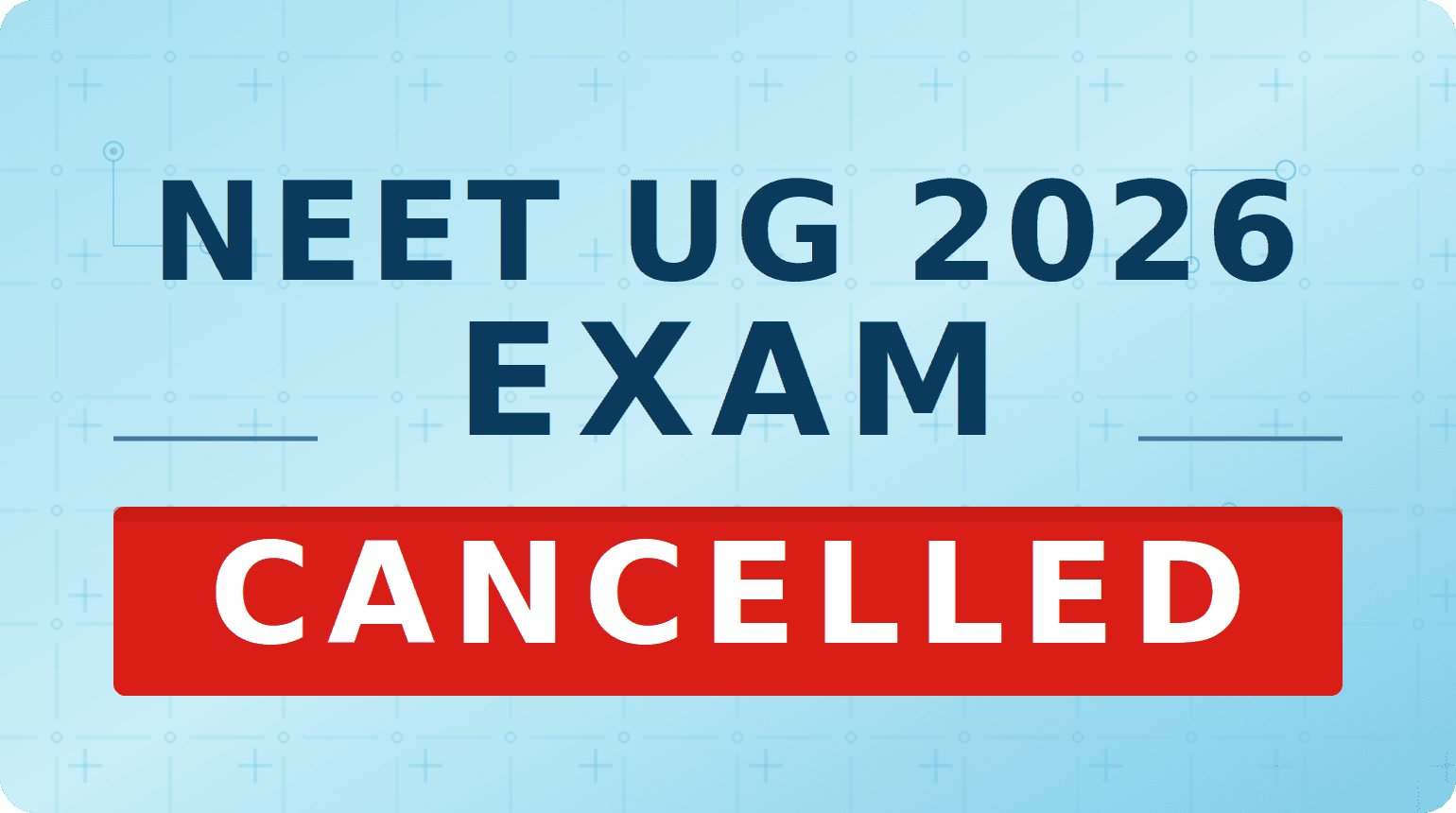
For the second time in three years, India's medical entrance examination has been cancelled amid a paper leak scandal. Behind the bureaucratic language of "transparency" and "re-examination" lies an unconscionable human cost — one that demands not just accountability, but a complete structural overhaul.
22.79L Students affected · 5,400+ Exam centres · 120 Questions leaked
On 3 May 2026, over 22.79 lakh students across India walked into more than 5,400 examination centres, carrying years of preparation, the sacrifices of their childhoods, and the collective dreams of their families. Nine days later, the National Testing Agency announced that their efforts amounted to nothing — the exam was cancelled. The Rajasthan Special Operations Group had found a handwritten paper whose 120 questions, including 90 from Biology and 30 from Chemistry, matched the actual NEET UG 2026 paper with damning precision.
The CBI has been called in. The NTA has issued measured statements. The government has expressed concern. And somewhere in a rented room in Kota, Pune, or Chennai, a student who has not slept more than five to six hours a night for the past eighteen months is staring at a ceiling, wondering if this nation will ever be fair to them.
"The examination may be re-conducted. The trust cannot be so easily restored."
The Human Cost
Let us not reduce this to a policy failure. Let us talk about the family in Margao whose daughter stopped attending her school sports team two years ago because NEET preparation left no room for it. The father in Vasco who chose not to upgrade his vehicle for three years so that coaching fees could be paid without strain. The mother who memorised her son's Biology syllabus to quiz him at the dinner table. These are not abstractions — these are the real stakeholders in NEET, and they have been catastrophically failed.
Students who appeared for NEET 2026 have called the cancellation "mental harassment" — and for once, social media outrage is entirely justified. A competitive examination is not merely a test of knowledge. It is the singular bottleneck through which nearly one million medical aspirants must pass each year to access approximately one lakh MBBS seats. The psychological weight of this compression is extraordinary even in ideal circumstances. When the examination itself becomes a casualty of institutional corruption, the damage extends far beyond the academic.
Anxiety disorders, depression, shattered confidence, strained family relationships, and in the most tragic cases, loss of life — these are the documented outcomes of examination-related stress in India's competitive exam ecosystem. A sudden cancellation does not merely add more preparation days; it adds weeks of acute uncertainty in which a student does not know when to peak, how to plan, or whether to trust the system at all. That psychological rupture has real, lasting consequences.
For parents, the wound runs even deeper. Most NEET aspirants' families have made significant financial sacrifices — coaching fees, study materials, accommodation in coaching hubs, and two to three years of direct income foregone while a child prepares full-time. A cancellation and re-examination does not merely cost time. It costs money they may not have, energy they are already running short on, and faith in a system that has asked them to bet everything on it.
"This is not the failure of one examination. It is the compounding failure of a system that has chosen convenience over integrity, time and again."
Why This Keeps Happening — A Systemic Analysis
It is tempting to frame this as a law enforcement problem — catch the culprits, prosecute them, and move on. That would be dangerously naive. Paper leaks in competitive examinations are not crimes of opportunity. They are crimes of architecture. They happen because the system is designed in ways that create structural vulnerabilities at every stage — from question paper setting to printing, distribution, transport, and examination-day logistics.
India conducts a pen-and-paper examination for over 22 lakh students simultaneously. The sheer logistical challenge of printing, sealing, and distributing question papers across 5,400 centres in a country of this diversity creates thousands of human touchpoints — and every human touchpoint is a potential leak. The more hands a paper passes through, the greater the surface area for compromise. This is not a criticism of individuals; it is a mathematical reality of operational design.
Compounding this is the prize at stake. A single percentage point difference in NEET rank can be the difference between a government MBBS seat and a private college charging ₹1 crore in fees. When the upside of cheating is this enormous and the probability of detection has historically been low, rational actors — both students seeking unfair advantage and criminal networks offering it — are incentivised to participate. The system has failed to raise the cost of cheating anywhere near the benefit.
The NTA has also suffered from a structural accountability deficit. With no published audit trails, no mandatory third-party oversight, and no independent quality assurance for examination processes, institutional complacency has been allowed to fester. Add to this the glacial pace of investigation and prosecution in previous cases, and the message sent to would-be perpetrators has effectively been: the risk is manageable.
What Must Be Done — A Prescriptive Framework
Recommendation 01 · NTA
Mandate Computer-Based Testing with decentralised question generation
The pen-and-paper model is an anachronism for an examination of this scale. India successfully conducts JEE Main, CUET, and CAT in CBT mode at scale. NEET must follow — not as a distant aspiration but as a legislated, time-bound mandate. A randomised question bank with algorithmic paper generation means no two students see the same paper in the same sequence, making the concept of a single "leaked paper" operationally impossible.
Recommendation 02 · Government
Establish an independent, statutory Examination Integrity Commission
NTA cannot be both the conductor and the auditor of its own examinations. An independent statutory body — with powers analogous to the Election Commission — must be created to oversee all national competitive examinations. This body should conduct pre-examination audits, manage question paper custody chain oversight, and investigate irregularities with suo motu powers, free of Ministry interference.
Recommendation 03 · Government
Enact a dedicated Public Examination Fraud Act with punitive deterrence
The existing provisions under IPC and IT Act are inadequate for the scale and sophistication of examination fraud. A dedicated legislation must classify paper leaks as a non-bailable, cognisable offence with mandatory minimum sentences of seven years, recovery of all assets derived from the fraud, and lifetime debarment from government examinations for those found guilty. The Public Examinations (Prevention of Unfair Means) Act, 2024, was a step — its implementation must be made iron-clad with no room for bail provisions being exploited.
Recommendation 04 · NTA
Implement end-to-end cryptographic custody for all question papers
Until CBT is fully implemented, every question paper must be encrypted at the point of printing, with decryption keys released only minutes before the examination begins — digitally to examination centre coordinators via a secure government server, under live surveillance. Physical custody must be replaced, wherever possible, with digitally encrypted distribution. Any centre receiving unencrypted materials should trigger an immediate alert protocol.
Recommendation 05 · NTA
Deploy AI-powered surveillance and biometric identity verification
Every NEET centre must mandatorily deploy AI-based live proctoring, biometric fingerprint matching at entry, and face-recognition verification tied to a national database. Impersonation — one of the oldest examination frauds — must be made technically impossible, not merely procedurally difficult. Real-time anomaly detection during the examination can flag unusual patterns before they become systemic.
Recommendation 06 · NTA
The selection of exam centres must be done with utmost scrutiny.
Every centre selected to conduct the NEET Exam must be chosen with the institution's previous track record and reputation in mind. Schools like KVs, Navodaya, Army Schools, and other reputed schools with a proven track record must be selected, and newly cropped-up schools with shady promoters must be avoided. In regions prone to such practices, extreme caution is warranted. If the region has a history of leaks, then those cities can also be avoided.
Recommendation 07 · Government
Decongest the bottleneck — reform the NEET-to-seat ratio structurally
No fraud-prevention measure will fully eliminate the incentive to cheat as long as 22 lakh students compete for 1 lakh seats. The Government must aggressively expand MBBS capacity — through greenfield government medical colleges, NMC-accredited private colleges with regulated fee caps, and regional expansion in Tier 2 and Tier 3 cities. When the prize is less existential, the desperation that enables fraud markets diminishes accordingly.
Recommendation 08 · Government
Provide immediate relief measures for 2026 aspirants
The current cohort must not be made to pay for institutional failure with time. Re-examination dates must be announced within 72 hours and held within 30 days. All students who appeared for the previous exam should be considered enrolled automatically, without requiring an application. A dedicated student helpline and counselling support must be activated.
The Larger Reckoning
India has a habit of treating its most hardworking young citizens as afterthoughts in the machinery of governance. The children who sit for NEET are not applicants to a government scheme. They are the future doctors of this country — the people who will one day staff its hospitals, staff its PHCs in rural districts, and hold the line in the next pandemic. They deserve better than a system that treats examination integrity as an operational inconvenience rather than a sacred obligation.
As someone who has spent over a decade and a half in the competitive examination coaching ecosystem — first as a faculty member at some of India's most established coaching institutions, and now as the founder of a multi-centre coaching institute in Goa — I have watched this crisis from every angle. I have seen the light go out in students' eyes when they fail. I have seen parents take loans to fund one more attempt. And I have seen, year after year, the same promises of reform produce the same failures.
The time for managed statements and incremental reforms has passed. The 22.79 lakh students who walked into examination centres on 3 May 2026 deserve a systemic response equal to the scale of what they have been put through. They deserve a government and an examining body that treats their dreams not as collateral damage in a governance failure, but as the core obligation around which every policy, every process, and every punitive measure must be designed.
"A nation that cannot conduct a fair examination has no right to demand that its youth compete fairly within it. Fix the system — not after the next leak, but now."
NEET 2026 · NTA · Paper Leak · Education Policy · Exam Reform · India
For the second time in three years, India's medical entrance examination has been cancelled amid a paper leak scandal. Behind the bureaucratic language of "transparency" and "re-examination" lies an unconscionable human cost — one that demands not just accountability, but a complete structural overhaul.
22.79L Students affected · 5,400+ Exam centres · 120 Questions leaked
On 3 May 2026, over 22.79 lakh students across India walked into more than 5,400 examination centres, carrying years of preparation, the sacrifices of their childhoods, and the collective dreams of their families. Nine days later, the National Testing Agency announced that their efforts amounted to nothing — the exam was cancelled. The Rajasthan Special Operations Group had found a handwritten paper whose 120 questions, including 90 from Biology and 30 from Chemistry, matched the actual NEET UG 2026 paper with damning precision.
The CBI has been called in. The NTA has issued measured statements. The government has expressed concern. And somewhere in a rented room in Kota, Pune, or Chennai, a student who has not slept more than five to six hours a night for the past eighteen months is staring at a ceiling, wondering if this nation will ever be fair to them.
"The examination may be re-conducted. The trust cannot be so easily restored."
The Human Cost
Let us not reduce this to a policy failure. Let us talk about the family in Margao whose daughter stopped attending her school sports team two years ago because NEET preparation left no room for it. The father in Vasco who chose not to upgrade his vehicle for three years so that coaching fees could be paid without strain. The mother who memorised her son's Biology syllabus to quiz him at the dinner table. These are not abstractions — these are the real stakeholders in NEET, and they have been catastrophically failed.
Students who appeared for NEET 2026 have called the cancellation "mental harassment" — and for once, social media outrage is entirely justified. A competitive examination is not merely a test of knowledge. It is the singular bottleneck through which nearly one million medical aspirants must pass each year to access approximately one lakh MBBS seats. The psychological weight of this compression is extraordinary even in ideal circumstances. When the examination itself becomes a casualty of institutional corruption, the damage extends far beyond the academic.
Anxiety disorders, depression, shattered confidence, strained family relationships, and in the most tragic cases, loss of life — these are the documented outcomes of examination-related stress in India's competitive exam ecosystem. A sudden cancellation does not merely add more preparation days; it adds weeks of acute uncertainty in which a student does not know when to peak, how to plan, or whether to trust the system at all. That psychological rupture has real, lasting consequences.
For parents, the wound runs even deeper. Most NEET aspirants' families have made significant financial sacrifices — coaching fees, study materials, accommodation in coaching hubs, and two to three years of direct income foregone while a child prepares full-time. A cancellation and re-examination does not merely cost time. It costs money they may not have, energy they are already running short on, and faith in a system that has asked them to bet everything on it.
"This is not the failure of one examination. It is the compounding failure of a system that has chosen convenience over integrity, time and again."
Why This Keeps Happening — A Systemic Analysis
It is tempting to frame this as a law enforcement problem — catch the culprits, prosecute them, and move on. That would be dangerously naive. Paper leaks in competitive examinations are not crimes of opportunity. They are crimes of architecture. They happen because the system is designed in ways that create structural vulnerabilities at every stage — from question paper setting to printing, distribution, transport, and examination-day logistics.
India conducts a pen-and-paper examination for over 22 lakh students simultaneously. The sheer logistical challenge of printing, sealing, and distributing question papers across 5,400 centres in a country of this diversity creates thousands of human touchpoints — and every human touchpoint is a potential leak. The more hands a paper passes through, the greater the surface area for compromise. This is not a criticism of individuals; it is a mathematical reality of operational design.
Compounding this is the prize at stake. A single percentage point difference in NEET rank can be the difference between a government MBBS seat and a private college charging ₹1 crore in fees. When the upside of cheating is this enormous and the probability of detection has historically been low, rational actors — both students seeking unfair advantage and criminal networks offering it — are incentivised to participate. The system has failed to raise the cost of cheating anywhere near the benefit.
The NTA has also suffered from a structural accountability deficit. With no published audit trails, no mandatory third-party oversight, and no independent quality assurance for examination processes, institutional complacency has been allowed to fester. Add to this the glacial pace of investigation and prosecution in previous cases, and the message sent to would-be perpetrators has effectively been: the risk is manageable.
What Must Be Done — A Prescriptive Framework
Recommendation 01 · NTA
Mandate Computer-Based Testing with decentralised question generation
The pen-and-paper model is an anachronism for an examination of this scale. India successfully conducts JEE Main, CUET, and CAT in CBT mode at scale. NEET must follow — not as a distant aspiration but as a legislated, time-bound mandate. A randomised question bank with algorithmic paper generation means no two students see the same paper in the same sequence, making the concept of a single "leaked paper" operationally impossible.
Recommendation 02 · Government
Establish an independent, statutory Examination Integrity Commission
NTA cannot be both the conductor and the auditor of its own examinations. An independent statutory body — with powers analogous to the Election Commission — must be created to oversee all national competitive examinations. This body should conduct pre-examination audits, manage question paper custody chain oversight, and investigate irregularities with suo motu powers, free of Ministry interference.
Recommendation 03 · Government
Enact a dedicated Public Examination Fraud Act with punitive deterrence
The existing provisions under IPC and IT Act are inadequate for the scale and sophistication of examination fraud. A dedicated legislation must classify paper leaks as a non-bailable, cognisable offence with mandatory minimum sentences of seven years, recovery of all assets derived from the fraud, and lifetime debarment from government examinations for those found guilty. The Public Examinations (Prevention of Unfair Means) Act, 2024, was a step — its implementation must be made iron-clad with no room for bail provisions being exploited.
Recommendation 04 · NTA
Implement end-to-end cryptographic custody for all question papers
Until CBT is fully implemented, every question paper must be encrypted at the point of printing, with decryption keys released only minutes before the examination begins — digitally to examination centre coordinators via a secure government server, under live surveillance. Physical custody must be replaced, wherever possible, with digitally encrypted distribution. Any centre receiving unencrypted materials should trigger an immediate alert protocol.
Recommendation 05 · NTA
Deploy AI-powered surveillance and biometric identity verification
Every NEET centre must mandatorily deploy AI-based live proctoring, biometric fingerprint matching at entry, and face-recognition verification tied to a national database. Impersonation — one of the oldest examination frauds — must be made technically impossible, not merely procedurally difficult. Real-time anomaly detection during the examination can flag unusual patterns before they become systemic.
Recommendation 06 · NTA
The selection of exam centres must be done with utmost scrutiny.
Every centre selected to conduct the NEET Exam must be chosen with the institution's previous track record and reputation in mind. Schools like KVs, Navodaya, Army Schools, and other reputed schools with a proven track record must be selected, and newly cropped-up schools with shady promoters must be avoided. In regions prone to such practices, extreme caution is warranted. If the region has a history of leaks, then those cities can also be avoided.
Recommendation 07 · Government
Decongest the bottleneck — reform the NEET-to-seat ratio structurally
No fraud-prevention measure will fully eliminate the incentive to cheat as long as 22 lakh students compete for 1 lakh seats. The Government must aggressively expand MBBS capacity — through greenfield government medical colleges, NMC-accredited private colleges with regulated fee caps, and regional expansion in Tier 2 and Tier 3 cities. When the prize is less existential, the desperation that enables fraud markets diminishes accordingly.
Recommendation 08 · Government
Provide immediate relief measures for 2026 aspirants
The current cohort must not be made to pay for institutional failure with time. Re-examination dates must be announced within 72 hours and held within 30 days. All students who appeared for the previous exam should be considered enrolled automatically, without requiring an application. A dedicated student helpline and counselling support must be activated.
The Larger Reckoning
India has a habit of treating its most hardworking young citizens as afterthoughts in the machinery of governance. The children who sit for NEET are not applicants to a government scheme. They are the future doctors of this country — the people who will one day staff its hospitals, staff its PHCs in rural districts, and hold the line in the next pandemic. They deserve better than a system that treats examination integrity as an operational inconvenience rather than a sacred obligation.
As someone who has spent over a decade and a half in the competitive examination coaching ecosystem — first as a faculty member at some of India's most established coaching institutions, and now as the founder of a multi-centre coaching institute in Goa — I have watched this crisis from every angle. I have seen the light go out in students' eyes when they fail. I have seen parents take loans to fund one more attempt. And I have seen, year after year, the same promises of reform produce the same failures.
The time for managed statements and incremental reforms has passed. The 22.79 lakh students who walked into examination centres on 3 May 2026 deserve a systemic response equal to the scale of what they have been put through. They deserve a government and an examining body that treats their dreams not as collateral damage in a governance failure, but as the core obligation around which every policy, every process, and every punitive measure must be designed.
"A nation that cannot conduct a fair examination has no right to demand that its youth compete fairly within it. Fix the system — not after the next leak, but now."
NEET 2026 · NTA · Paper Leak · Education Policy · Exam Reform · India